
Features
In the order the work happens.
A deposition moves through six stages between the court reporter and the courtroom. Soltris is organized the same way.
Import, without ceremony.
Point Soltris at what the court reporter sent. Single files or a batch, and the witness, volume and page structure come from the file itself, so a twelve-deposition production lands as twelve organized transcripts, not a folder of filenames.
Prior work comes along. If years of annotations and designations live in spreadsheets from an older system, they load against the matching transcripts, and anything that would land twice is caught instead of doubled.
In the box Text, PTF, XMEF and MDB transcripts. PDF when nothing better exists. CSV for annotation and designation history.
Read it the way it was taken.
The viewer keeps the reporter's page and line numbering, because that numbering is the coordinate system of the whole case. Jump to a cite, search the full text, and mark as you go.
An annotation covers exactly the lines you select, holds a note and issue codes, and stacks: three annotations on one answer stay three separate thoughts, not one merged blob. The margin shows everything at a glance before a word is read.
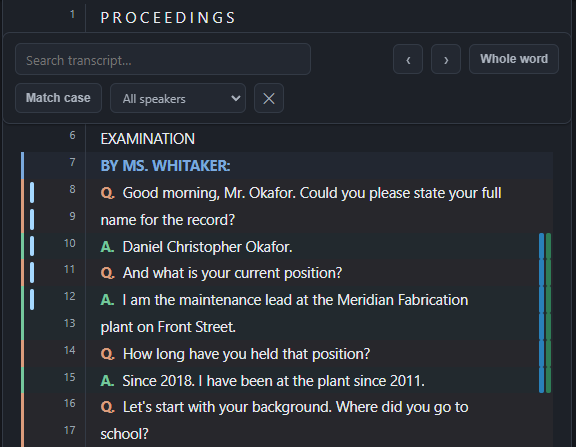
In the box Full-text search. Range annotations, several per line. Issue codes. Margin bars for annotations and designations.
Designations that survive the meet-and-confer.
Mark ranges for each party, layer counter-designations over them, and attach objection notes where the fight will be. Overlaps are normal and the display keeps them legible.
Below the transcript, the dock holds the full set in page order. On the eve of a deadline, that list is the work: walk it top to bottom, resolve each one, and nothing hides on page 214.

In the box Party and counter-designations. Objection notes. A page-ordered dock, every entry one click from its testimony.
The testimony, spoken.
When a deposition arrives with video, the transcript and the footage are already married by the reporter's timecodes. Click a line and playback lands on that moment, across volumes and across the multi-part recordings long depositions produce.
Cut clips by page and line for the pretrial exchange or the jury, with the audio in a format every system plays.
In the box Synced playback from XMEF and MDB packages. Click-to-seek. Clip export by page and line, MP3 audio.
A chronology that argues back.
Facts carry their proof. Each entry holds a date, the issues it touches, and citations to page and line; click one and the testimony opens where the witness said it. Exhibit references open the exhibit.
Sort by date to see the story, filter by issue to see the argument. Deleted facts are recoverable and every deletion is on the record, which matters in a tool used by teams under discovery obligations.
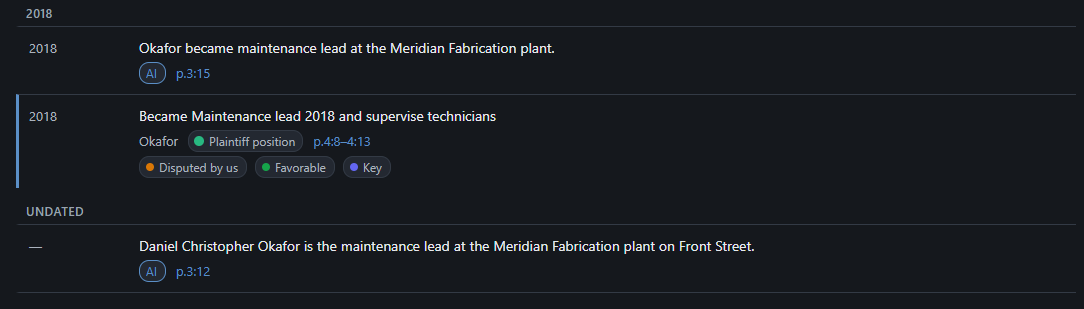
In the box Date and issue views. Page-line citations that jump. Exhibit links. Recoverable, logged deletion.
Produce the record.
The Printed Transcript renders the work back onto the page: designation marking in the margin, annotation bands where notes live, filtered to one party when that is what the exchange requires. It is the document a partner carries into the room.
Seven reports cover the rest, to PDF for filing and Excel for working, and the same CSVs Soltris reads, it writes, so nothing that goes in is ever stuck. In the PDF, every margin marker links to its appendix entry, the full note, the issue codes, the citation, and the appendix cites back, so the paper copy loses nothing.
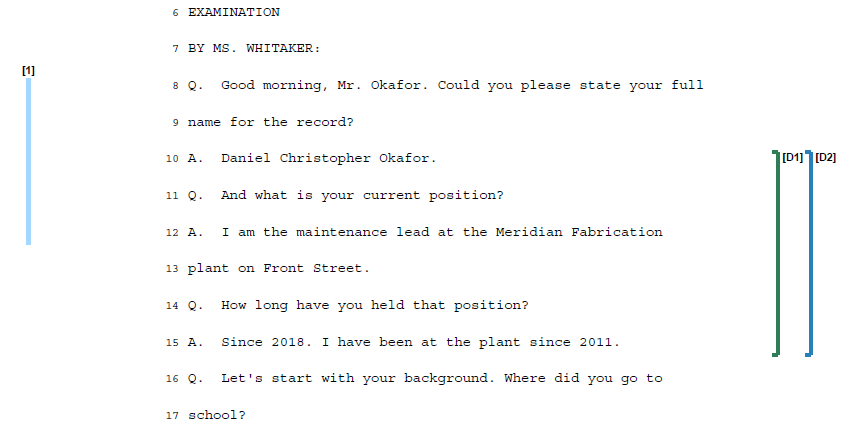
In the box Printed Transcript with party filter. Seven reports to PDF and Excel. CSV out for everything CSV brought in.
And the parts with their own pages.
What the AI does and where it runs is on the AI page. Roles, audit and the questions IT asks are on the security page.